
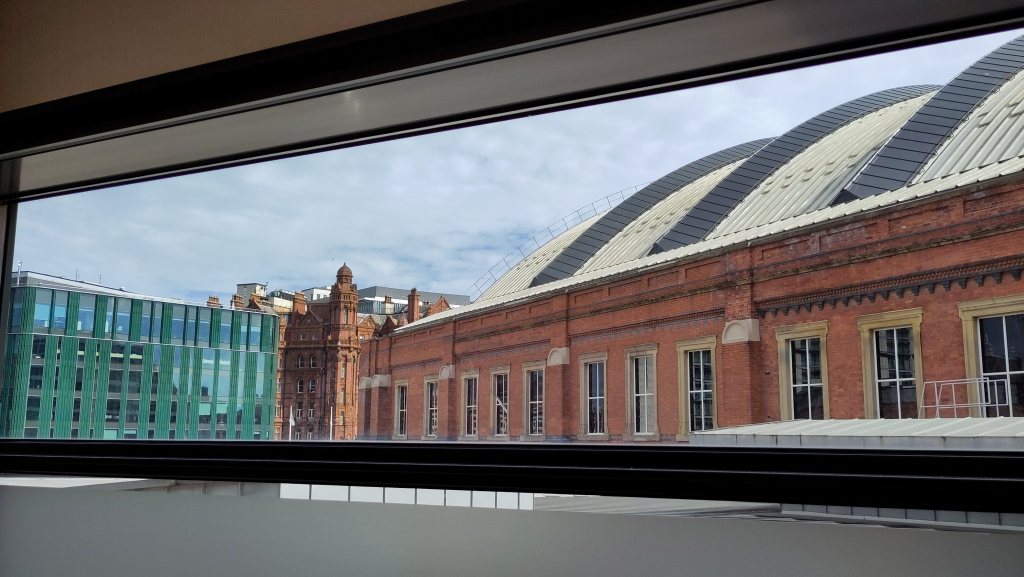
Back on the in-person speaking trail after quite a long time away, I was invited to speak at Digital Government North about “the human side of digital transformation”. I liked the way the organisers drew together the themes of working with users, frontline staff, and digital specialists. Cheekily, I reused the same slides and outline last week when invited to talk with Government Digital Service colleagues as part of their speaker series. I enjoyed being back at GDS’s Whitechapel HQ for the first time in ages. The talks went something like this…
It’s 2023, we made it!
Transformation: a show of hands. Is it all about the tech? Or is it all about the people? Trick question! It’s both.
Of course, transformation is all about the people, but the year is 2023, what transformation isn’t also deeply entangled with digital, data and technology?
2023 is a special year for the NHS – it’s our 75th birthday.
As part of that, I volunteered back in July to go and give a talk about the NHS to a hall full of year 10 pupils at a school in Bradford. It was terrifying. They asked great questions, like what I enjoyed most about my job, and how much I get paid. But that question about digital versus humans didn’t come up.
It’s 2023, digital is the water in which we all swim.
The unity of the highest technical achievement with a deep focus on human needs is at the heart of the National Health Service.
This is from the NHS Constitution for England:
“The NHS works at the limits of science – bringing the highest levels of human knowledge and skill to save lives and improve health.”
… also, this:
“The NHS touches our lives at times of basic human need when care and compassion are what matter most.”
We fail as a service if we lose sight of either part of that mission.
And this fits well with my favourite definition of digital, which I think captures those two elements well.
“Applying the culture, processes, business models and technologies of the internet era to respond to people’s raised expectations.” – Tom Loosemore
Yes, it’s about technology and the internet, but digital also create new expectations, and comes with new processes, business models and culture. You can’t do one without the other. You gotta catch ‘em all.
But this definition of digital begs two questions:
- Which people?
- What expectations?
I’m going to focus in this talk on three groups, whose involvement and collaboration is essential for the modern NHS to succeed.
I’m coming at this from the perspective of health and care – but if you work with other parts of the public sector, you can probably think of equivalents. When we talk about the human side of digital transformation, these are the humans I’m thinking about.
Patients & carers (but for this read citizen users of your service too)
As a universal service, the NHS is here for everyone in the country, but certain groups of people are more likely need our help more often.
How we interact with people will be massively different if they’re generally in good health – getting advice on a minor ailment, or vaccination to help them stay well – or if they’re acutely unwell or are living with multiple long-term conditions that mean they interact frequently with many parts of the health service.
Parents, family members, friends, carers also play a role in supporting the health of the people they care for, so we can never assume that a health service is used by an individual in isolation.
Through our research, patients tell us they have hopes and fears for digital in their healthcare services.
They welcome the perceived speed and convenience. They worry about losing the human touch of in person care.
They make sophisticated judgements on the digital services that work for them, and the ones that don’t.
They worry about digital exclusion for groups that face specific barriers such as disability and language.
But I’ve also heard from disabled people for whom digital is a lifeline, enabling them to access services they previously found hard to reach by phone or in person.
I used to think that frontline was an inappropriate metaphor in health and care. People’s lives should never feel like a warzone.
The pandemic changed my mind.
When I saw pictures from Covid wards and talked with clinical colleague who had been redeployed back to care for patients in this terrible situation, I understood the difference between my comfortable working-from-home office job and the people who donned protective equipment to give hands-on, life-saving care.
I’ve made peace with the term “frontline”.
Those jobs come is so many sorts. Clinical and non-clinical:
- the health advisor who answers a 111 call not knowing whether it could be a sore thumb or a cardiac arrest
- the pharmacist working evenings or weekends to fulfil emergency prescriptions
- the GP receptionist at 8am on a Monday morning
- the hospital doctors and nurses caring for patients and families at the most stressful times of a person’s life
They’re all on the front line, and many more.
Our health and care workforce is massive – about 1.5 million people – so it’s no surprise that their expectations of digital reflect the populations they come from. We have everyone from the most enthusiastic to the most sceptical.
The sceptics have good reason. Often where staff are dubious about the benefits of digital it is because they’ve been bitten before by promised improvements which turned out to make things harder.
A small percentage – but still a big number – lack basic digital skills.
Many have those skills; they may be avid smartphone users in their personal lives but lack they the confidence to apply that knowledge in the workplace.
Among that 1.5 million are our digital specialists.
When you Google for a health problem, and the top result is from the NHS website, the words you read, which guide, and hopefully reassure, have been written by one of our team.
If you have the misfortune to have to go to an urgent treatment centre when you’re on holiday in another part of the country, the staff there will be able to check the basic details of your medical record thanks to the efforts of our data standards and care records teams.
When you get a prescription from your local pharmacy, the details have been transmitted electronically from the doctor who prescribed it because of our digital teams’ work.
And they want the same as everyone else: they want digital tools that enable them to do their job.
If their expectations of tech at work seem higher, that’s because these are the fundamental tools of their job. If you were going for an operation, you’d want the surgeon to have the best surgical instruments.
More than that, our colleagues tell us they value the ways of working and the culture that enable then to work at pace, to make a difference for patients. And that’s not always easy inside a massive, complex system.
For our people, we have committed to work with a product mindset.
This is based on the things we know digital teams need to make the biggest impact:
- Delivering the right thing: using evidence to check that we’re contributing to better outcomes
- Empowered multi-disciplinary teams who can continuously make the changes that deliver the most value for users
- Continuously improving: learning with our users, making rapid iterative change
- Understanding user needs to ensure our products and services are useful, usable, accessible, and equitable in line with our organisation’s constitution.
These things are part of our employee promise to digital specialists, but the impact should be felt much more widely than that. If we’re working with a product mindset, frontline staff should feel the benefits, and ultimately patients and carers will know it too, as they get faster, better outcomes.
The softly spoken bit where the screen goes blank
What makes this especially powerful in the public sector is that the relationships between these groups are not purely transactional.
We’re able to work together with the public – we’re on the same side, motivated by the same purpose – our winter ad campaign for the public is badged “Help us help you”.
What possibilities this opens for service design! When you can start with the presumption that all the actors involved in the service – patients, carers, frontline staff, digital specialists – want the same thing.
To be part of the solution.
Patients and carers want the digital NHS to succeed. More than 30 million adults in England have downloaded the NHS App.
Our frontline staff value having access to patient’s information at the point of care and being able to refer digitally to other services.
Thousands of digital professionals got a taste for working in health and care during the pandemic and are sticking with us as we recover services and look to the future beyond recovery.
There is a downside to this.
Staff are so motivated by the purpose that when they cannot give the best care to their patients, they suffer personal, moral injury. Burnout is real, and it affects digital specialists as well as frontline staff. As digital leaders, we owe it to all our colleagues to remove the barriers that prevent them doing their best work.
How do we make it sustainable for all the people involved?
I turn to one of the agile manifesto principles – perhaps the most surprising to people who misinterpret agile as “doing waterfall only faster.”
“Agile processes promote sustainable development. The sponsors, developers, and users should be able to maintain a constant pace indefinitely.”
This is how we expect consumer tech to work.
The major operating systems and digital service providers are moving away from big, highly disruptive releases, with lots of new things to learn at once. The best digital services just work. Updates are very frequent but come with a low burden of learning and adaptation.
And that’s how we’re changing the way we deliver digital products and services in NHS England.
Away from timebound programmes with big, risky release dates at the end.
To sustainable products and services that deliver for the organisation, are sustainable for the teams that work on them, and critically, respect the capacity of frontline services to absorb change.
This month we’ll release the integration of 111 online into the NHS App across 100% of England. But we started small – with just 5% of areas, scaled to 30% then 60%, learning and checking the impact at each step.
Bringing people together
When I was asked to speak about this topic, what particularly appealed to me was the way the brief drew together three questions:
- How to help users acclimate to the rapidly evolving technologies?
- How to engage busy staff with low digital skills in digital transformation?
- How to create a world leading, sustainable digital workforce?
3 massive challenges.
And I realised that rather than addressing each group in isolation, that answers to the questions lay in thinking about what they have in common, and finding new ways for those groups to relate to each other.
The first new way is to bring patients and the public closer to service design and decision-making – to co-design care that works for them. They are the experts.
When you do that, prepare to be surprised if the things patients care about aren’t the same as the things you started a piece of work to address.
We have a brilliant patient and public voice board for the Digital Urgent and Emergency Care area, focused on mental health.
Members of that group talked powerfully about experiences of themselves or a loved one being in mental health crisis. As a result, the group has fed into the specification of new vehicles used in crisis response.
We convened them thinking they would help us with digital, but we let them lead us to the problems they cared about most deeply.
Our NHS people are also finding new ways to relate to each other across organisational boundaries, as part of new Integrated Care Systems, bringing together all the NHS and partner organisations in an area.
Because they have a remit to collaborate across boundaries, some of the more advanced ICSs are getting to grips with problems of technical interoperability that are key to delivering multi-organisation, patient-centric health and care.
The organisational structure is starting to shape how we address technology, but in a good way.
And our digital teams are also getting out of their silo and becoming a fully integrated part of the new NHS England following the merger with NHS Digital and Health Education England earlier this year.
We’re replacing ‘internal commissioning’ between different arms-length-bodies with joined-up business planning and a more iterative dialogue between business needs, technology considerations, and budgetary constraints.
Our shared goal is to help the NHS transform and improve the health and care of the people it serves.
All the people we work with – in whatever role – are part of a society that faces common challenges:
- an aging population,
- the way big data and AI are reshaping our information environments,
- the imperative to decarbonise when 4% of the country’s carbon emissions come from the health and care sector.
We need a systems thinking approach to making our service sustainable. How do each of the three groups fit in, and crucially what can they get from the others?
So, I’ve been thinking about the flow of ideas and inspiration between the three groups, and how to turn it into a virtuous circle.
Digital team members of course bring their own experiences as service users to their work. We have colleagues – perhaps too few – with deep lived experience of using our services.
But there’s also a risk when our digital teams are not as diverse as the communities they serve and are too distant from the realities of service delivery.
Digital specialists + frontline staff
Putting digital specialists together on a very frequent basis with frontline staff means they get direct feedback on the realities of delivering the service.
Some members of my team were in a 111 contact centre last week, listening to calls and observing how health advisors use our products to help patients.
They came away full of ideas for how we can make things better for our users.
Frontline staff can also bring indirect insight into the needs of their users – patients and the public, but there’s also a risk here that they project their own knowledge and expectations onto other people.
Amazon founder Jeff Bezos says, “your brand is what people say about you when you are not in the room.” What do NHS frontline staff say about digital when we’re not in the room? All sorts of things!
In any workplace people help each other to solve problems and share their understanding of how something should be done. We need to get ahead of the word-of-mouth assumptions which get passed around.
By using networks of frontline staff champions, as the NHS App team do, we can increase the chances of positive digital behaviours being shared and embedded in place of negative perceptions or clumsy ways of doing things.
Frontline staff + patients and the public
Frontline staff are in contact with patients and the public every working day. They receive feedback – good and bad – about their services, but when the problems are to do with the digital part of the service, do they know what to do with it? Giving staff ways to feedback what patients are telling them, and get things fixed, goes a long way to changing the conversations they have with patients about tech.
In a large, complex service organisation, it’s easy to turn inwards for solutions, and to underestimate the role that user – in our case patients and the public – play in coproducing the outcomes that our service is here to enable.
We can either empower people with tools and services that put them in control, or inflict tech that disempowers, that becomes another source of stress and exclusion for people already at a low ebb through worry or illness.
Of course, patients and carers look to the frontline staff who care for them for practical support with digital, as well as for clinical care and emotional support.
But they also have powerful mutual support networks that are often invisible to professional service providers. One of the unexpected joys of working with patient and public voice boards is seeing the supportive relationships that develop between members of these groups, who share experience of needing NHS care and of navigating the system. We under-estimate public word-of-mouth at our peril.
Patients and the public + digital specialists
By getting out of the building, and working directly with patients and the public, digital teams have much to give, and much to gain. For everyone on a digital team, reading patient feedback, observing user research, and visiting service user groups refreshes their sense of motivation and purpose, and helps them to focus on the real problems they are here to solve.
But the inspiration can work both ways. We can bring the public into our spaces too. Earlier this summer, we invited members of the Digital Urgent and Emergency Care Patient and Public Voice group to visit our teams at the Government Hub in Leeds. It took quite some arranging, but it was totally worth it.
They visited the operations centre, where our service management colleagues monitor and support the national digital infrastructure underpinning 111 and 999.
We invited patients into the user research lab observation room, where our teams are usually hidden watching them use our products in usability tests. We had lunch together and dropped crumbs on the observation room floor.
And we got them trying out the kit in our accessibility lab. This is where teams test their products to make sure they’ll work for everyone.
They used screen readers, simulations for different visual, auditory, and cognitive disabilities, special glasses that simulate specific visual impairments, and gloves that reduce your manual dexterity – try using a smartphone impaired by arthritis or Parkinson’s.
So, I want to end my talk with a quote from Angela, one of our PPV Board, who wrote this on her train journey home from Leeds…
“How proud I am to be part of this great British institution and the progress, advances, and enthusiasm I came across, with such talent – but not boastful of their talent… No wonder we are looked to from across the globe as pioneers.”
What better way to inspire our colleagues than in the words of the public we are all here to serve?
 Matt Edgar writes here
3 thoughts on “The humans of digital transformation – a talk for Digital Government North, and reprised for the GDS Speaker Series”