
As part of the NHS 75th anniversary year, I volunteered to give a talk to the year 10 students at a high school in Bradford. They listened well and asked good questions. These are my notes, more or less as delivered on the day…

In the Summer of 1948, leaflets like this were dropping through the letterboxes of millions of homes in the United Kingdom. The leaflets announced the creation of a new thing called the National Health Service. Before 1948, hospitals were run by lots of different organisations, and many people had to pay to see a doctor. If someone in your family got ill, you wouldn’t just worry about whether they’d get better, you would also be worried about whether you could afford to pay for their treatment.

Here’s a government minister called Nye Bevan, visiting a hospital in Manchester on the first day of the new National Health Service. He said: “A person ought to be able to receive medical and hospital help without being involved in financial anxiety.”
And here’s what the leaflets said about the new National Health Service:
“Everyone rich or poor, man, woman or child–can use it or any part of it. There are no charges, except for a few special items. There are no insurance qualifications. But it is not a “charity”. You are all paying for it, mainly as taxpayers, and it will relieve your money worries in time of illness.”
A lot has changed in the 75 years since the NHS started. The UK has more people, who on average are living longer, healthier lives. With medicine like vaccinations, we have stopped some diseases spreading through the population, and scientists have found cures for others. We have amazing surgeries, including transplants – Britain’s first kidney transplant in 1960. Today there is keyhole surgery using robots.
We can give hope to couples who couldn’t have children using in-vitro fertilisation (IVF). In 1978, the world’s first baby to be conceived via IVF was born at Oldham and District General Hospital.
In 2022 alone, robotics systems have helped to treat patients with prostate cancer and get them back to their homes in less than 24 hours after surgery. We saw new drugs for cancer, and the first new treatment for sickle cell disease in over two decades.
The NHS is governed by something called the NHS Constitution. Here’s what it says:
The NHS works at the limits of science – bringing the highest levels of human knowledge and skill to save lives and improve health.
Recently the NHS pioneered the world’s first rapid whole genome sequencing service for seriously ill babies and children. In the future, we might be able to use every baby’s genetic profile to understand their risk of developing particular diseases in later life and help them live in good health for even longer.
But it takes more than amazing scientific skill and endeavour. The NHS constitution also says:
The NHS touches our lives at times of basic human need when care and compassion are what matter most.
When we’re ill, or a loved one is sick, we need kindness too. Could you be one of those people, who can pair real intellectual skill with the skill of making people feel OK, even when they’re going through a hard time?
The NHS is massive: around 1.5 million people work in it. But that also means we make a massive impact on the environment. About 4% of the country’s carbon emissions come from running health services. The NHS has an essential role to play in meeting the net zero targets set under the Climate Change Act. How about making life-saving ambulances that are electric vehicles instead of petrol or diesel?
The NHS belongs to the people. But even though people don’t have to pay for NHS treatment, there are still inequalities between rich and poor areas, and between different communities.
What is this scatterplot telling us?

People who live in deprived areas are on average likely to die years younger than people in wealthy areas. The north of England has more deprived neighbourhoods than the south of England. For women, the gap between the area with the lowest life expectancy (Blackpool, at 79.5 years) and the area with the highest (Westminster, at 87.2 years) is 7.7 years. For men, the gap is 10.5 years, also between Blackpool (74.4 years) and Westminster (84.9 years).
In the future, we need to get even better at preventing ill health, making the care we give more personalised – better suited to each individual. And while a lot of the money in the NHS goes to big hospitals, in the future we aim to deliver more care closer to home. Already more than 100,000 patients have been treated in NHS virtual wards, using the latest technology to free up capacity in our hospitals and allow patients to get care at home.
If we’re going to keep making a difference for another 75 years, we need all the help we can get. And this is what makes a career in the NHS so special.
So who am I to stand at the front of this hall and talk to you about all this stuff?
I’m not a doctor, or a nurse, or a pharmacist, or a dentist. I’m not a scientist, though I work with some awesome ones. My first job was as a newspaper journalist. But when I was young I was fascinated by computers. So I left my job in a newspaper to join a company putting news online. At the time, the editor said to me: “Matt, if this Internet thing doesn’t work out, you can always come back.” That was a long time ago, and it seems to be working out so far.
I worked for the mobile operator, Orange, some of you might remember that? And then I got involved in helping the government and the public sector go digital. That led me to the NHS. Like a lot of my colleagues, I wanted to use the skills I had gained through my schooling, university, and career in other industries, for the benefit of patients and frontline NHS staff.
I’m lucky to be in a senior role. I am well paid for what I do. But when I joined the NHS, I wasn’t looking for a pay rise. What I earn now, adjusted for inflation, is about the same as I was on when I worked for a telecoms operator, but I have a lot more responsibility now than I did back then. At Orange, I used to work with the latest mobile phones, and downloadable games and apps.
In the NHS I lead teams of people who use digital technology to support the parts of the health service that deliver Urgent and Emergency Care – things like ambulance services, and A&E departments. Same skills, very different impact on people’s lives.
If you or a family member has a health emergency or an accident, and you call 999 or 111, it’s likely the people who help you will be using the tools that my teams build and run.
Who knows when you should call 999? Only if it’s a life-threatening emergency.
And if it’s not an emergency, where should you go? Your GP, an Urgent Treatment Centre, or you can use 111 online or by a phone call.
I understand that you’re missing science and maths to listen to me. So I’m going to show you some of the things we work on in my bit of the NHS, and as I do, have a think about how we’re using science and maths.
This is 111 online.
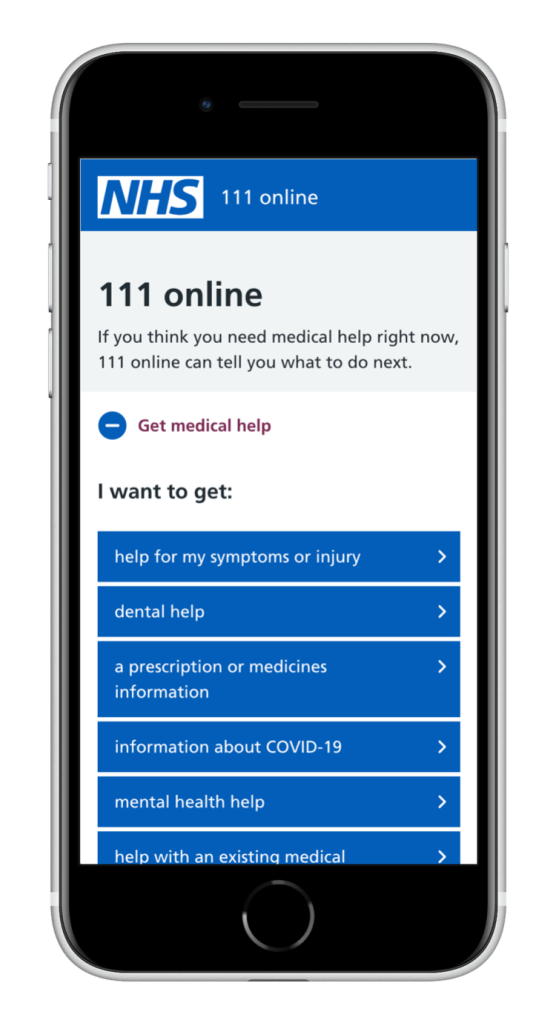
Did you ever play those games where you choose your own adventure? 111 online is like that but for illness. If you’re not sure what to do about a health problem, answer some questions, and depending on your answers we’ll ask you some more questions. If you’re really sick, we might send an ambulance, or get you a phone call from a doctor or nurse. It might be that we suggest you could go to a pharmacy, or see your regular GP. Or if it’s something you can manage yourself, we might give you advice on how to look after yourself at home and what to do if it gets worse.
All of that is science! The team who write those questions, and decide what order to put them in, include medical professionals, who use their own medical knowledge and look at the latest scientific evidence to make sure they give advice that’s safe and effective.
But medical professionals sometimes use too much medical jargon, so we pair them with user researchers and content designers – people who were paying attention in English Language class – who help make sure everyone will be able to understand the advice.
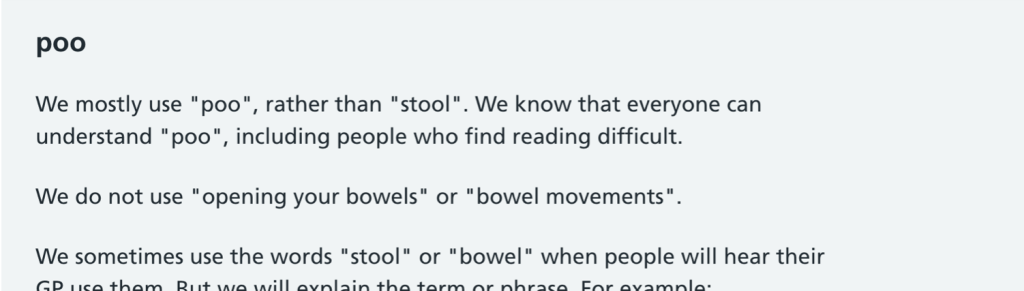
If you work in the NHS, you need to get comfortable talking about all kinds of subjects!
Then we have data scientists who look at all the routes that people take through the service, and see where people get stuck, or where they drop out, and help us make the service easier to use, and more likely to get you the best advice. We use data to explore what people were recommended to do, what they actually did, and what health outcome they got.

Suppose we’re recommending that people with a particular condition go to an Urgent Treatment Centre, but more than average in one area still go to A&E. By finding this out, the people who run local health services can think about why that might be happening, and start to improve their services.
We have to be really careful with that data because it’s people’s private information. So my teams work hard to make sure it’s anonymous and cannot be linked back to any individual. We need to make sure that people have a choice in how we use their data. We have strict controls on who is allowed to work with this data, and what they’re allowed to do with it. And we have to keep it safe from accidentally leaking information, or from cyber-criminals who might try to hack into NHS systems.
What do you think this service might look like in the future? I don’t know the answer to this question, I need your help…
Would you trust an AI chatbot to give you health advice?
Some people say that we could automate the simple things that happen in a 111 call, like asking your date of birth and location, so we can free up the human staff to do the more skilful things that humans do best. We can also use machine learning to spot patterns in our data that we might not have noticed, and them build them into the next versions of our service.
But if we’re going to use AI for decisions that affect people’s health, we need to be sure it’s safe. Some computer scientists can’t really explain how their AI algorithms come up with the answers they give. I think you’d lose marks in a maths paper if you got the answer right but didn’t show your working. So some of the doctors in my team are working with computer scientists to look at “explainable AI” – methods to get computers telling us things we don’t know, but also showing how they worked it out.
In NHS England, I’m lucky enough to work with lots of different professions to make things better for patients and frontline staff. I’m confident if you go on the health careers website you will find something in the NHS that could be a job for you.
- Doctors – General practitioners, or lots of specialities working in hospitals and the community.
- Nursing – might specialise in looking after children, or in mental health.
- Midwifery, and health visitors
- Pharmacy
- Ambulance team – paramedics, call handlers, dispatchers, 111 health advisors
- Radiographers, physiotherapists, speech and language therapists
- Dental team
- Psychotherapists and psychologists
- Healthcare science – life sciences including genomics.
- Digital – developers, designers, product managers, user researchers, data scientists, cyber security
- Management – HR, Estates and facilities
- Public health – in the community, school nurses
- Wider healthcare team – receptionists, administrators, support workers
Some of these roles are highly competitive and academically demanding. You are going to really have to commit to gaining the scientific and other skills to get into those professions. Some roles have a specific training route and need academic qualifications, for example the allied health professions, medicine, nursing and pharmacy. For others, you can study a range of different subjects and apply them to jobs in the NHS. There are also routes through apprenticeships and traineeships. People in the NHS are always learning on the job and have opportunities progress no matter what level they join the organisation.
We need a diverse workforce that reflect the diverse communities we serve. What really matters when you’re joining a values-based organisation like the NHS are the transferrable skills and behaviours, which you can learn and demonstrate in lots of different ways.
When I think about the teams I work with, there are a few things that lots of the people have in common.
- Compassion – How do you respond when you see a friend or classmate having a hard time? The NHS touches people at some of the lowest points in their lives. Earlier this week, I visited the intensive care department at Leeds General Infirmary, where the nurses were caring one-to-one for patients who were very sick. As well as using their scientific knowledge and skills to keep people alive, they were caring for the patients and their families as human beings.
- Curiosity – The people I work with in the NHS are always asking why. They want to know what’s causing an illness, or why there’s a crowd in the emergency department. They’re always thinking about what people need, and how could we meet their needs.
- Fairness – We have to make services that work for everyone. For example, my team always think about how their service might work for people who speak different languages, are blind or partially sighted.
- Teamwork – Bringing all your skills and counting on others who can do different things to you. Almost everything worthwhile that happens in the NHS is the result of teamwork between people who couldn’t do what they do without other people to support them. You have lots of different ways to practice and demonstrate teamwork in school or college.
Here’s where to look if you want to find out more.
You can learn more about working in the NHS on the Health Careers website. There you can take a careers quiz to find the NHS career that best suits you.
There are volunteering or work experience opportunities in many local NHS organisations, and Speakers for Schools helps with NHS work experience placements that take place all over the UK.
And then there are other things you could do to support the NHS in its 75th year.
- Giving blood (most people aged between 17 and 65 can donate)
- Supporting NHS research projects – The Born in Bradford study is tracking the health and wellbeing of over 13,500 children, and their parents born at Bradford Royal Infirmary between March 2007 and December 2010 – one of the largest research studies in the World.
- Supporting NHS charities – I said the NHS is not a charity, but there are charities that work alongside us. Some support research and development to cure diseases, some help by brightening up hospital environments, some provide state-of-the-art technologies and equipment, and some support NHS staff.
Thank you for listening. Your generation has a lot to deal with, and you have your whole futures ahead of you. If you work hard and apply yourself in your studies, you will find incredibly rewarding opportunities for you. We have lots to do! I’m happy to answer any questions.
 Matt Edgar writes here