
The view I chose for the top of my five year reflections no longer exists. A year ago, I captured a beautiful fiery sunset over Leeds city centre from the window of Quarry House. If I stood in the same spot today I’d see only the brick slip clad walls of the massive new block of flats that blots out the afternoon sun from reaching the NHS’s labyrinthine northern HQ. (That’s a Good Thing by the way: there’s a housing crisis, people need new homes.) Gone the way of the view is the NHSX Digital Transformation Directorate that I joined in 2021 and had the privilege of leading for a few months on an interim basis.
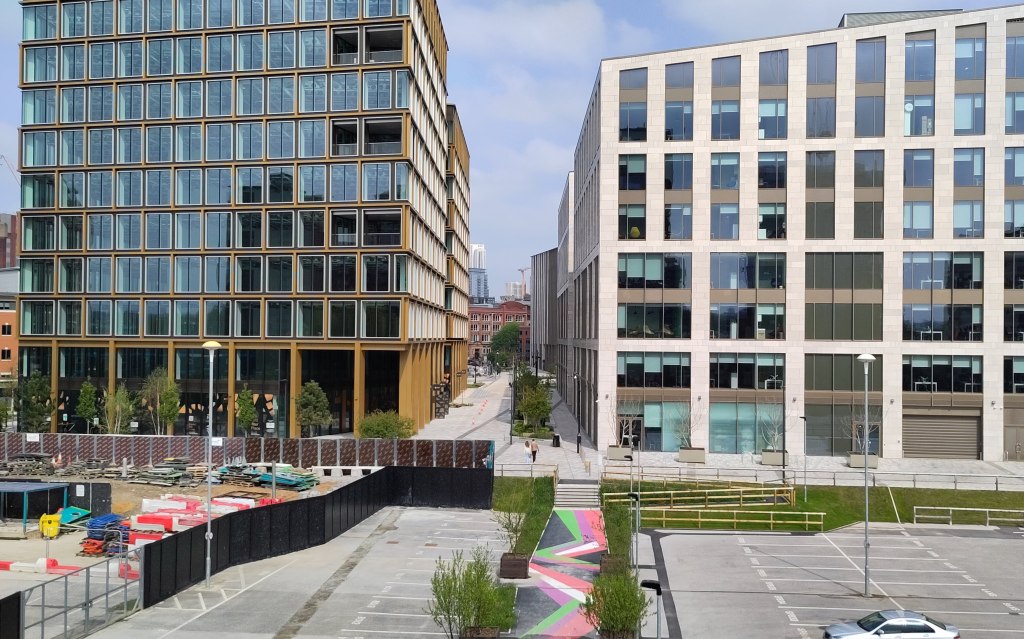
Instead, for my sixth year, I offer you a prospect of the new new office on the other side of the city, the modern and spacious government hub at Wellington Place. I’m enjoying my cycle commutes through the smart end of town, the palatial bike storage and showering facilities in the basement. Up on the 5th floor, I work alongside colleagues from the former NHS England and former NHS Digital which have merged, along with Health Education England to form a new national organisation for the NHS. Back in August, my own team became a trailblazer ahead of the legal merger when I was asked to head up both the NHS Digital and NHS England teams working on digital in urgent and emergency care (UEC). More later on how that’s going.
A new NHS England
Pay no attention to the mere coincidence that the new organisation happens to also be called NHS England. My colleagues and I are determined that this merger must create something new, and not be a takeover by one of the legacy arms-length bodies, especially the least digitally mature of the three. Talking to colleagues facing successive waves of change in leadership and processes, it has not always felt like that. We are losing some valued colleagues through voluntary redundancy just at the time when we need skilled and experienced people to deliver for patients and frontline staff.
Is all the talk of NHS reorganisations in my weeknotes boring you? I’m boring myself now. My leadership role in the changes is also tinged with my memories of institutional trauma in another large organisation, whose senior leaders have since been held accountable for the human cost of their approach to transformation.
What keeps me going is that creating a single national body for the NHS, with digital and workforce at its heart, is the right thing to do. I cling to the line I quoted this time last year from Laura Wade-Gery’s review of digital transformation in the NHS national bodies:
“Replace formal ‘internal commissioning’ between NHSEI and X and NHSD with joined-up business planning and a more iterative dialogue that navigates between business needs, technology considerations, and budgetary constraints.”
And from the Messenger Report, ‘Leadership for a collaborative and inclusive future‘:
“The sense of constant demands from above, including from politicians, creates an institutional instinct, particularly in the healthcare sector, to look upwards to furnish the needs of the hierarchy rather than downwards to the needs of the service-user.”
If we can achieve the pivot those paragraphs represent – from internal boundary-riven to truly patient-centred – then the pain will be worth it. We just need to look after ourselves and each other along the way.
Strategy and delivery
Please don’t read into my context-setting above that we’ve been wholly self-absorbed these last 12 months. Delivery goes on despite the distractions and drags imposed on team performance. The following are just some of the year’s achievements, which I list to give a flavour of what we’ve been up to. I cannot take personal credit for this. It’s the work of many people and teams, some directly in my portfolio, and others close by. I hope I do my bit to create the conditions for them to perform.
Over the past 12 months we’ve focused on the sustainable adoption, operation, and continuous improvement of national digital products and services that support the management of urgent and emergency care demand through 111 and 999. Our teams supported providers through an incident response, and made steady progress with evidence of benefits and performance indicators for our work. Some evidence of digital’s measurable contribution to system performance remains frustratingly elusive though because we’re not yet able to join up data from every part of the complex health and care system.
Colleagues have worked hard at collaboration between digital, policy, and operational teams. This bore fruit in the form of a clear and prioritised plan for the re-platforming our UEC Directory of Services, a critical enabler to getting patients to the most appropriate care. I sometimes hear a perception that senior stakeholders are too interested in shiny new functionality and never enough in the unseen efforts that underpin operational resilience. The focus on the Directory of Services shows that it is possible to make a case for investment in a platform. Members of my team contributed to strategy work that fed into the UEC Recovery Plan published in January. Work to build on the success of the NHS App and national digital channels is a focus in 2023-24, requiring us to collaborate with colleagues in other teams including primary care.
The twists and turns of the NHS’s efforts to achieve interoperability between its many organisations and systems continued to take up a lot of my time. So much of UEC depends on the fast and secure flow of information where and when it’s needed. Way back in my December 2019 update, I mentioned an impending discovery called Book, Refer and Manage Appointments. The pandemic meant a refocusing of that work, and the Booking and Referrals Standard that grew out of it is now published as version 1.0. We expect it to be the default way of referring patients from 111 to emergency departments and urgent treatment centres. As more use cases are supported, reaching wider than UEC, the standard is expected to become ubiquitous. We’re also rolling out data dashboards that allow service providers and commissioners to understand patient flow from initial triage through to health outcomes.
For all the focus on technology and data enablers which the NHS badly needs, health and care is still a people business. Last year I said I wanted to build on existing user-centred design and patient and public engagement practices to make Digital UEC an exemplar of equitable co-design in health and care. The work my team initiated to understand people’s expectations and experience of urgent and emergency care proved timely and was used to inform the UEC strategy and Recovery Plan. I continue to be humbled by the Digital UEC Patient and Public Voice Board, who are getting back into the groove of in-person meetings and site visits. And I have continued to observe user research when invited to do so. The “last observed primary user research” counter at the top of my Mastodon profile helps me to be publicly accountable for getting my 2 hours every 6 weeks.
Learning and leading
Part of our organisational shift is away from managing everything as projects and programmes towards a multidisciplinary team structure centred on enduring products and services. So ironically the main learning and development I have done this year is the Project Leadership Programme at Cranfield University. I’ve tried hard to put aside my scepticism about the applicability of “project leadership” to public service transformation, and to engage positively with the learning and networking opportunities that the programme gives me. My fellow participants are all committed public servants with amazing stories to tell and shared problems that come with getting things done in any large organisation. I’m learning a lot from them.
For the past few months, I’ve been working with the combined leadership of the teams we’re bringing together to establish the joined-up, flexible way of working that the merger makes possible. In some cases I have tried to move too fast and had to slow down so that leaders can learn to trust each other and find a consensus at their own pace. The looming re-organisation leads to some challenging behaviours, and makes it hard to create a psychologically safe space for these conversations to take place. It still takes far too long to start up new pieces of work in response to user or system needs, and that’s a source of frustration for everyone involved.
As part of my Cranfield studies I chanced upon the silent killers of strategy implementation and learning, which I used as the basis for a survey among colleagues. It highlighted a particular gap in the way we engage “middle managers” in strategy-making and storytelling. A few weeks ago we gathered most of the leadership in a windowless room at Quarry House for a series of activities and conversations to raise situational awareness and surface our strategic choices. Seeing the energy in that room, and hearing the openness to new directions for our products, renewed my optimism that we can turn this around.
In my 3 year reflections, I wrote that “leadership for me is the long, thoughtful, steady progress of building capability in individuals, teams, and organisations.” That’s still where I stand. The current delivery window is narrowing, and we’re on the cusp of new possibilities, new technologies, and new models of healthcare. Our job is still to start with user needs, and then to apply our diverse skills and lived experiences into services that make things better.
 Matt Edgar writes here
One thought on “Another view: Reflections on a sixth year in the NHS”