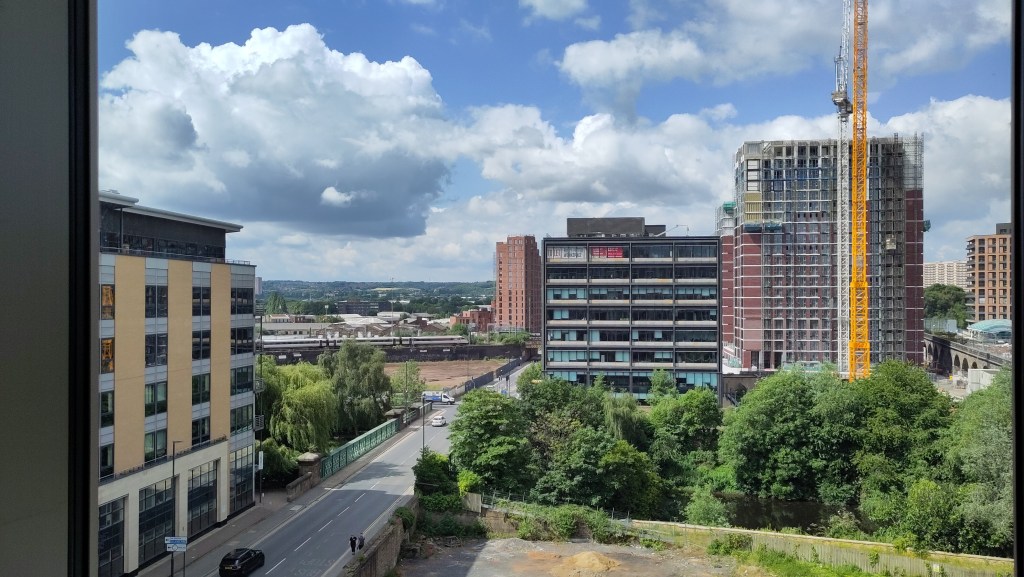
Five days enjoying the air conditioned Leeds office. I cycled in every day. On Thursday and Friday, I took longer, cooler, more scenic routes home rather than slog back up Chapeltown Road in the early evening heat. Even though most of my meetings were on Teams, I gain a lot from being in the same space as colleagues working on other things. Reflecting on this post by Mat (with one T), it’s important to reflect on what we’ve lost and what we’ve gained since the rapid and enforced switch to remote-first in March 2020.
How did I work with my team this week?
A few weeks ago, I rejigged the cadence of one-to-ones I have with colleagues, so I was seeing everyone in my extended leadership team on an individual basis at least once every 3 weeks. That’s working really well for me (though I can’t speak for the colleagues in question).
I also carved out time to spend with particular teams. I joined the first part of the show and tell for the NHS Pathways clinical decision support system whose triage algorithms underpin all of NHS 111 and many 999 calls too. Colleagues shared the work they’ll be releasing in the coming months as part of the cycle of continuous improvement to keep the algorithms safe and effective for patients and the staff who support them.
I also had a really productive hour working in a shared document with the product manager, designer, and user researcher on NHS Service Finder, a service for health professionals to find the right urgent service when they know what kind of care their patient needs, but not what’s open and available to them right now. Together we wrote down the skeleton of a product strategy, covering some of the strategic decisions that the teams need to make with their stakeholders in the coming weeks and months. I want to use this as an example of how regularly maintained product management artefacts can give greater assurance than the one-off options appraisal contained in a traditional programme business case.
There were still things to take care of across the team too. One of my direct reports had a medical emergency and will be off work while they get better. The team has sent a gift and best wishes for a speedy recovery. I also needed to support some colleagues to make sure they got accurate information as part of our corporate re-organisation. Everyone is trying the best they can, but it is a complex process with different choices for individuals to make at different points.
Who did I talk to outside my organisation?
On Monday, I had a preparatory call with a staff member from a local high school where I’m due to give a talk coinciding with the NHS’s 75th birthday in July. I’ve done lots of public speaking in my time, but 240 year 10s might be the toughest audience I’ll ever face. It really helped to understand what the school wanted pupils to take away from my talk, and to anticipate the questions they’re most likely to ask.
Tuesday was a day of oversight and assurance boards: one for the work we’re doing to make the most of our patient-facing national digital channels, and then the regular Digital Urgent and Emergency Care (UEC) board, which I chaired in my colleague’s absence. We covered a wide range of topics in the Digital UEC board, including:
- Messages sent to a GP surgery after their patient has been in touch with 111
- A long-standing service that highlights when patients are calling repeatedly with potentially worsening symptoms
- Work by Digital UEC teams to support the changing role of pharmacy in meeting patients’ urgent needs
- An update from our clinical director on how we’re anticipating risks and designing in clinical safety as we integrate 111 online with the NHS App.
On Wednesday I joined the monthly meeting of ambulance service Chief Digital and Information Officers. Topics on their agenda that my team had a particular interest in included:
- Progress on modern, standards-based bookings and referrals when calls are passed between ambulance services, and from 999 into clinical assessment services
- A review of how mobile devices are used by paramedics on scene, and what we can learn from the different ways they have been deployed by each of the trusts.
On Thursday and Friday, I collaborated with UEC colleagues on a briefing for ministers, and attended a regular ministerial update on one of our initiatives.
What do I need to take care of?
Also on Friday, I had a final session with the coach I’ve been working with as part of the Project Leadership Programme. Over the past few months, I’ve been fortunate to have four sessions with my coach, and each of them has focused on a different aspect of my leadership: how I work with my merged team, how I relate to senior leaders in the complex and shifting NHS landscape, and how I bridge the two so that teams are better connected to the strategic priorities that matter to our stakeholders.
In my final coaching session – and also in a rushed one-to-one towards the end of the day with Helen, my executive director – I reflected that we are making steady progress, despite the forming and storming that comes with the merger of 3 organisations into the new NHS England. Things that seemed hard a few months ago feel more under control as more members of the team step up and lead on top priorities and important inter-team relationships.
As we head towards the summer holiday season, I need to focus on a few important things:
- Our longer term digitally enabled vision for the “front end” of the urgent care journey, where patients seek help and get an initial assessment. We need multiple teams to be able to carry this forward through several separate but related pieces of work
- The implementation of organisation changes for my team members, in a way that’s fair to all, and sets everyone up to do their best work once they’re settled into teams in the new structure
- Ensuring that everyone has clear and transparent, objectives that interlock each other, and with our directorate business plan. These are essential to give assurance that we’re all working together towards the most important outcomes.
Something that caught my attention this week
While doing my Saturday housework chores, I enjoyed listening to this podcast with Intel’s Elizabeth Anne Watkins on the Social Science of AI. I hope you will too. (Hat tip to Antonio Santos who shared it on Mastodon.)
 Matt Edgar writes here